
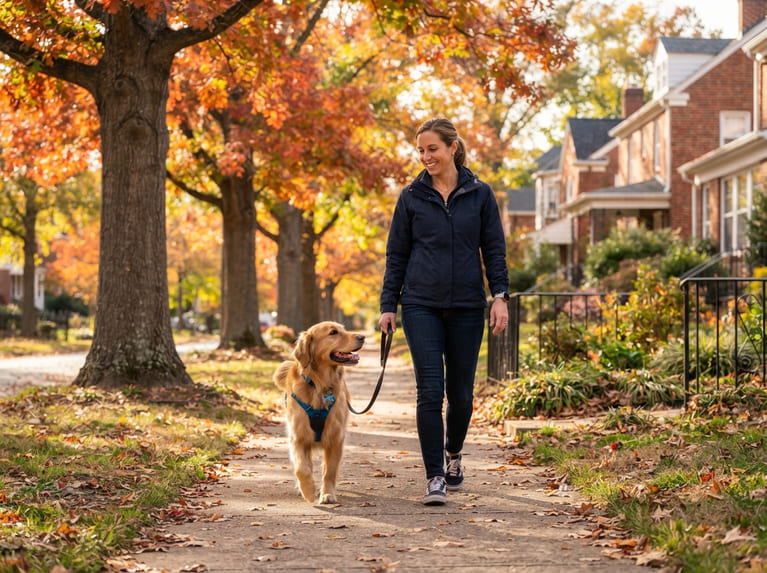
Most people do not want a dog that can perform tricks on command in a quiet room. They want a dog that waits at the door instead of bolting, settles while they cook, comes in from the yard the first time they call, and leaves the dropped chicken alone. That is what real obedience is for.
This post focuses on obedience at home: the handful of skills that make daily life easier and how to build them into your routines. If you are working on taking your dog everywhere, our post on building a take-anywhere companion covers public outings. Here we stay closer to home.
What "obedience" really means at home
Obedience is often thought of as a list of commands. In practice, it is about your dog understanding a few clear expectations and being able to follow them in the moments that matter: the front door, the kitchen, the yard, the couch, and the car.
A useful way to think about it: for each common daily moment, what do you want your dog to do instead of the thing it is doing now? Then teach that one thing, clearly and consistently.
Before you start: check with your vet if anything changed
If your dog has suddenly stopped responding to cues it knew well, see your vet first, because hearing loss, vision changes, and pain often look like a dog "ignoring" you. Older dogs in particular deserve a check before you assume it is a training problem.
### 1. Sit as a default "please"
A dog that sits to ask for things is easy to live with. Ask for, and reward, a sit before:
- The food bowl goes down
- The leash goes on
- The door opens
- You throw the ball
- You pet the dog when you come home
Over time, many dogs start offering a sit on their own because it is how good things happen.
### 2. Wait at doors and gates
Door dashing is dangerous. Teach your dog to wait while the door opens and until you release it.
- Start with the door closed. Ask for a sit or stand, reach for the handle, and reward when the dog stays.
- Open the door a crack. If the dog moves forward, close it gently. If it waits, reward and release with a cue like "okay."
- Build up slowly to a fully open door, then to stepping through first, then to having someone outside.
Use a leash or a gate for safety while you practice. For more on the front door with visitors, see dogs that react at the front door.
### 3. Go to your place
A bed or mat where your dog can settle is one of the most useful skills you can teach. It helps during meals, cooking, visitors, work calls, and family time.
- Lure or invite your dog onto the mat and reward.
- Reward for lying down on it, then for staying a few seconds, then longer.
- Add mild distractions: walking around, opening the fridge, sitting down to eat.
- Keep the mat a great place to be, with chews and calm praise.
### 4. Leave it
"Leave it" can prevent a vet emergency. It means "don't touch that."
- Start with a treat in a closed hand. When your dog stops sniffing and backs off, reward from your other hand.
- Progress to a treat on the floor under your hand, then uncovered with you ready to cover it.
- Practice with toys, food on low tables, and items on walks.
- Always reward with something better than what was left.
### 5. Come when called
A reliable recall is a safety skill. Make coming to you the best deal in the house.
- Call once, in a cheerful voice, and reward generously when your dog arrives.
- Practice in the house, then the yard, with a long line for safety outdoors.
- Never call your dog to you for something it dislikes, like a bath or nail trim. Go get it instead.
- Do not repeat the cue over and over. If your dog does not come, make it easier next time.
In many suburban yards, from Chesterfield subdivisions to older lots in Tuckahoe, the yard is the best recall practice space you have. Start there before you ever try it anywhere bigger.
Three helpful extras
Once the core five are in place, these make home life even smoother.
### Drop it
"Leave it" prevents grabbing. "Drop it" handles what is already in the mouth. Practice with a toy your dog likes: offer a treat near its nose, say the cue as it lets go, reward, and give the toy back. Giving the item back often keeps your dog happy to drop things. If your dog stiffens or guards when you approach its things, stop and read up on resource guarding before you practice this.
### Polite greetings
For puppies who greet with teeth, see puppy biting help.
Jumping is usually a dog trying to say hello. Teach that four paws on the floor earns attention. Turn away calmly when your dog jumps, and greet it when it stands or sits. Ask visitors to do the same. A leash or gate helps during practice.
### Settle in a crate or pen
A dog that can relax in a crate or pen is easier to manage during visitors, repairs, travel, and vet stays. Make it comfortable, feed meals there, give chews there, and build up time gradually. It should never be used as punishment.
Obedience for families with kids
Children can be great training partners with the right setup.
- Give kids simple jobs, like asking for a sit before tossing a treat.
- Keep sessions short and supervised.
- Make sure kids use the same cue words as adults.
- Teach children not to chase, hug, or corner the dog.
- An adult should handle door waits, leash work, and anything involving food bowls.
Obedience for older or newly adopted dogs
You can teach an old dog new tricks. Older dogs often learn well, but they may need shorter sessions, softer surfaces, and adjustments for stiff joints, hearing, or vision. Newly adopted dogs may need a few weeks to settle before training feels smooth. Start with easy skills, build trust, and keep it low pressure.
Build obedience into your day
Obedience sticks when it is part of life, not a separate session. Some easy ways to practice:
- Mealtime: sit and wait before the bowl goes down.
- Leash time: sit while the leash goes on, wait at the door.
- Cooking: go to place while you work in the kitchen.
- TV time: place on the mat with a chew.
- Yard time: a few recalls with rewards, then back to playing.
- Coming home: greetings happen when all four paws are on the floor.
A few seconds here and there, many times a day, adds up quickly.
Making skills reliable
- Practice in many places. Kitchen, hallway, yard, driveway. Dogs learn behavior in context.
- Add one difficulty at a time. Longer duration, more distance, or more distraction, not all three at once.
- Keep sessions short. A few minutes is plenty.
- Reward generously early on. Fade treats slowly, and keep using real-life rewards like play, sniffing, and going outside.
- Use the same cue words across the household.
- End on a success.
What about off-leash obedience?
Many owners want a dog they can trust off leash. That is a big goal, and it should be built carefully. It depends on a reliable recall, solid "leave it," and steady attention under distraction, practiced with a long line in safe areas first. Always follow local leash laws and posted rules wherever you are.
Common mistakes
- Repeating cues. "Sit, sit, SIT" teaches the dog the first two do not count.
- Training only in one room. The dog learns the skill only works there.
- Moving too fast. Asking for a long stay in a busy room before a short one works in a quiet one.
- Calling the dog for bad things. Ruins recall.
- Inconsistent rules. One person allows the couch, another does not.
- Only practicing when there is a problem. Practice in calm moments makes the hard moments easier.
- Punishing slow responses. Usually makes a dog less eager.
When to get a pro
- Your dog is not responding even with consistent practice.
- Obedience falls apart around visitors, other dogs, or the front door.
- There is reactivity, fear, or any aggression involved.
- Several people in the house train differently.
- You want help moving to off-leash reliability.
For leash manners, see loose leash walking step by step.
Try this week
- Ask for a sit before every meal and every leash-up.
- Practice door waits with the door closed, then cracked.
- Put a mat in the kitchen or living room and reward settling on it.
- Do three "leave it" sessions with a treat in your hand.
- Practice five recalls a day in the house or yard.
- Agree on one set of cue words for the whole household.
- Book a vet check if your dog's responsiveness changed suddenly.
Getting started
Want obedience that holds up at your own front door and kitchen? Call or text (804) 885-2424, or book a consult.
More: Off the Leash · Services · About